Showing posts with label Durga Maa. Show all posts

Wednesday, 25 March 2015

Day 9 - Goddess Siddhidatri

Day 9 - Goddess Siddhidatri


Goddess Siddhidatri is the ninth form of NavDurga who is worshipped on the ninth day of Navratri. On this final day of pooja, the goddess is revered with great dedication remembering their prayers for each of the nine days. The ninth form Siddhidatri is the final manifestation of Shakti and is paid homage for gaining all Siddhis. This includes wellbeing, health, protection from evil, courage and wealth. This truly resonates in her name ‘Siddhidatri’ – one who bestows all siddhis.
She looks magnificent sitting on the lotus, radiantly smiling with her bright eyes. She has four arms, each of them holding a piece which signifies the Siddhis. Gada – to protect from all evil and diseases, Chakra – to keep the enemies away, Conch-shell – to bring in the positive waves in life with its sound and Lotus flower- the ultimate symbol of wealth and prosperity.  She wears a red saree which is an ominous colour in Hinduism. She rides on her vehicle Lion. Worshipping her on the final day of Navratri marks successful completion of devotee’s offerings, prayers and penance during the Navratri.
She is said to be bestowed with eight powers of Anima, Mahima, Garima, Laghima, Prapti, Prakambya, Ishitva and Vashistva.  Anima is to be able to reduce oneself to a singular atom, Mahima is to expand oneself, Garima is becoming one with more weight of glory, Laghima is becoming weightlessness to float on air, Prapti is to be able to access all places, Prakambya is ability to manifest things into reality, Ishitva is to reach higher and Vashistva is ability to defeat and conquer all.  It is said that Siddhidatri devi blessed Lord Shiva with all the Siddhis which were required to run the universe. It is this when the half female form was realised by Lord Shiva as ‘Ardhanareshwar’.
She governs Ketu providing the direction, energy and guidance to the planet and its effects on humans. She is renowned as the supreme goddess of power – ‘Adi-parashakti’.  She is worshipped by Humans, Ghandharva, Asuras, Yakshas, Siddhas and even Gods.
Goddess Siddhidatri is revered for ultimate perfection and harmony in life.  With her blessings one can achieve glory, physical wellbeing, and mental agility to accomplish things and peace and joy to enjoy life. Achieving siddhi enables a man to enjoy glory and recognition for his work. With the grace of Goddess Siddhidatri all the wishes can be fulfilled for a content life. Each of the nine days are important. The final day of Navratri also signifies the end of the Navratri during which the devotees offer their unwavered dedication and reverence seeking blessings for better life and pardon for their sins. On the ninth day the devotees perform Yagna, Maha puja and other celebrations to mark the culmination of their reverence to NavDurga.

For more blogs click here

Day 8 - Goddess Maha Gauri

Day 8 - Goddess Maha Gauri


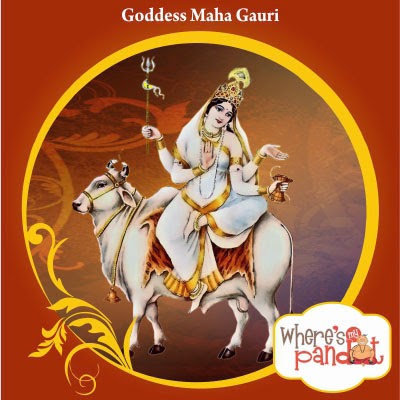
Each of the nine forms of Maa Durga is manifested during the holy celebrations of Navratri to seek blessings from the ultimate “Adi-shakti” who created this universe and further nurtures and protects it. Maha Gauri is the eight manifestation of Devi Parvati who is worshipped on the eight day of Navratri. She is the protector who brings an end to all the sufferings in human life. She blesses her loyal devotees by fulfilling their desires.
Outwardly she appears divine. Her name Maha Gauri means extremely white which also symbolically means pure. Her complexion is radiant and white shinning brilliantly. Her complexion is compared to white conch shell, moon and white flower of Kunda. She wears a white sari and rides white bull. Hence she is also known as “Shwetambardhara”. She has four arms. On her upper left hand she holds a ‘Dumroo” while the other left arm is held up in blessing. Upper right arm holds a trident spear while the lower right arm is held up gesturing removal of fear.
Devi Parvati observed intense penance to marry Lord Shiva. When Lord Shiva was pleased he awarded her with a boon that he will marry her and she will be his wife soon. Lord Shiva cleansed Devi Parvati in the water of Ganges. This made her skin shine bright white. Thus he named her Maha Gauri.  
She is known to be the purest form among the NavDurga.  Hence performing a pooja for her on the day of Ashtami is considered auspicious. This day is celebrated with fervour and devotion to Maha Gauri avataar of NavDurga. It is said that whoever prays to Maha Gauri with pure heart and good intentions is never returned without their prayers being answered. Ashtami pooja is also seen as a culmination of all the prayers and offerings made the earlier days to different forms of NavDurga and bowing to the ultimate pure form of Devi Parvati to seek what your heart wishes. Bhog of various delicacies is offered to Maa Durga. Kanya Pujan (Worshiping and offering food to nine little girls) is done as a symbol of offering food to Maa Durga’s purest form as kids are considered pure at heart. These nine little girls are considered to be the forms of nine avataars of Maa Durga. Worshiping her on ninth day is rewarding. Many unmarried woman also worship her to get her blessings for finding a good husband and leading a happy, joyous and long married life. Ashtami pooja ritual marks the cleansing of our souls of all the unwanted worries, the darkness as she is also a goddess of kindness and morality. She brings peace and prosperity to the pious souls of devotees. 

Day 7 - Goddess Kaalratri

Day 7 - Goddess Kaalratri


On the seventh day of Navratri, Goddess Kaalratri is revered. As one of the most violent forms of Maa Durga, she is worshipped with great dedication. She is said to be so fierce that her appearance itself instils fright in the mind of evil. Although to her loyal devotees she brings peace and courage. She is the bearer of light for those who seek answers. She is the destroyer of all evils, demons, spirits, ghosts and negative energies.
In Devanagri scripture “Kaal” means time and death, and the word “Ratri” means the night. In true spirit the name “Kaalratri” translates into the destroyer of darkness and evil. This swaroop or avataar of Goddess Durga is the fiercest indicating that life is balanced with both positive and dark side. Kaalratri represents that life has the fierce darkness or violence which creates mayhem as well as does good. She is revered by her devotees with great dedication wearing blue, red or white colours on this day
Her appearance is one that brings fear at first look. Pitch dark complexion, bountiful weathered hair, three eyes, and four hands with one left arm holding a cleaver and another left arm holding torch. The right arms are gesturing Abhaya and Vardana mudras, promising blessings and freedom from fear for her devotees. She adorns a necklace glinting with moon-shine.  She rides a donkey, often seen as donkeys’ corpse. Dressed in tiger skin around her waist she looks ferocious with a garland of severed human heads around her neck and two severed heads as her earrings. She blows hot flames through her nostrils while inhaling and exhaling her breath.
As per a known legend, there was a demon Raktabeej, who was awarded a boon by Lord Brahma that every drop of his blood that fell on earth will produce another clone of his. In effect, this promised him eternal life that no one can kill him. After receiving the boon, he started creating havoc on earth and heaven alike destroying villages and town, killing sages and innocent humans and even torments Gods. Gods went to Devi Parvati in the time of distress. She promised to stop Raktabeej from creating further mayhem. Meanwhile Raktabeej was stoned in his own power, claiming every life on his path. Screaming at top of his lungs that no one can kill him or stop him. Goddess Parvati saw this from the skies and disappeared. However her voice echoed in skies “I will stop you”. Raktabeej saw up but couldn’t see anyone. The voice echoed on and suddenly in his front appeared a form so ferocious all black batter hair, severed skulls in her neck waving cleaver riding a donkey chasing towards him. She was an incarnation of Devi Parvati - Goddess Kaalratri. Raktabeej ran to save himself. After a long battle Goddess Kaalratri decapitated him and drank all his blood to prevent it from dropping on earth, thus killing him.
The appearance of Maa Kaalratri is perilous for the evil-doers but for her followers she provides courage and protection from evil.

Tuesday, 24 March 2015

Day 6 - Goddess Katyayani


Devi Katyayani is the sixth form of Goddess NavDurga and is worshipped on the sixth day of Navratri. She is known as a pure Shakti form, a remover of severity and pride. She is a warrior goddess in a fierce form and is also known as “Bhadrakali” and “Chandika”. She has been noted as one of the ancient known forms of energy with mentions in Skanda purana and Patanjali’s Mahabhasya written in 2nd BCE. She is said to have taken form out of anger of Gods against the Demon Mahisasur.
Her outer appearance is fierce warrior-like with four hands. She bears a long sword on her left arm and lotus in another one. Both right arms are up in benevolent gesture of blessings. She rides a lion which was given to her by Devi Parvati to slay the demon Mahisasur. In Hindu traditions like Yoga or the Tantra, she is recognised as the sixth Ajna Chakra or the 'Third eye chakra', and her blessings are besought by concentrating on this point.
Goddess Katyayani is believed to be born to Sage Katyayan in Durga Avataar hence known as Katyayani Mata. With the growing mayhems caused by Demon Mahisasur, Gods were distressed. Growing powerful and evil day by day he planned to destroy the earth, heaven and rule Gods. Katyayani Mata was manifested by Gods to destroy Mahisasur. Mahisasur was blessed by Lord Shiva for his Tapasya that he cannot be killed by anyone either on heaven or earth, nor when he is a human or animal. When Katyayani Mata was chasing Mahisasur, he was changing into a form of buffalo. Just when his head transformed into animal, Katyayani Mata jumped onto his back and beheaded him with one blow of her sharp sword. In the end the Gods and earth were saved from total annihilation from demons.
In 22nd chapter of the Bhagvatpuran the legend of Katyayani Mata is recorded, when young single maids or Gopis worshipped her by observing fast on Katyayani Vrat for the entire month of Margashirsha (first month of winters) to have Lord Krishna as their husband. The ritual followed by bathing at Yamuna River and offering prayers to the Goddess including betel nuts, flowers and incense. The ritual is followed till date to get the husband one wants.
Devi Kanyakumari (at the southernmost tip of India) is said to be a re-incarnation of Goddess Katyayani. She is ardently worshipped during Pongal with prayers for good rain, abundance and prosperity throughout the month. She is also a goddess of Penance and Sanyas. It is believed that the planet Brahaspati is governed by her and she is known as a pure primal form of Shakti.

For more blogs click here

Monday, 23 March 2015

Day 5 - Goddess Skanda Mata


Navratri is a celebration of devotion to “Adi-shakti” Ma Durga. Each of her nine forms are celebrated across these nine days. Goddess Skanda Mata is the fifth manifestation of Devi Parvati. In this form she is recognised as a mother of Lord Skanda (Lord Kartikeya), who is a chosen leader of gods to lead in wars against demons.
Devi’s avatar is seen with the infant form of Lord Skanda in her lap. She has four arms and three eyes and she is riding on a lion. She carries lotus in two of her arms, one arm holding Skanda and the other one holding up in a gesture bestowing blessings on the devotee. She is also seen meditating on the lotus thereby bearing the name “Padmasanadevi”.
According to a legend Tarkasur, a great demon, once did tough penance to please Lord Brahma. Pleased with his great devotion Lord Brahma appeared. Tarkasur asked Lord Brahma to shower his blessings and make him eternal; for which he denied and said, “No one can escape death, as death is already predestined for everyone who takes birth on this earth.” Tarkasur acted clever, he thought Lord Shiva will never get married and thus, asked for death by the son of Lord Shiva. The blessings were granted. Tarkasur started tantalizing the people on the earth. He considered himself as unbeatable. Feared with the actions of Tarkasur all the Devtas went to Lord Shiva and requested him to get married. Lord Shiva agreed and got married to Goddess Parvati. She then gave birth to Lord Kartikeya or Skand Kumar, who demolished Tarkasur. Devi Skand Mata represents mother-son relationship. Her worship automatically includes the worship of Lord Kartikeya (in his child form).
Skanda Mata is a goddess of beauty, purity and grace. Worshippers seek spiritual upliftment and a peaceful journey in another world by invoking Skanda Mata. This journey provides a true meaning to Siddhi and Mokhsa for devotees where they leave their sorrows behind to lead a better life in contentment.
The fifth day of Navratri also marks the “Visudh Chakra” during Durga Puja which means a devotee prays and remembers the Goddess with his or her undiluted devoting thoughts and prayers. This removes impurities, anxieties and other bearings on their mind bringing peace to them. The pooja on Panchmi is also significant to achieve Skanda Mata’s blessings for a peaceful life ahead.

Day 4 - Goddess Kushmanda


Each of the nine forms of Goddess Durga is worshipped with devotion and love by her disciples during the nine days of Navratri dedicated to each form of the Goddess. Goddess Kushmanda is the fourth avataar of Devi Parvati who is worshipped on the fourth day of the Navratri by offering reverence.  She is a gentle graceful form of dignity and divine energy smiling back at the universe and blessing it, hence the name “Kushmanda”. The name Kushmanda is derived from the words “Ku” meaning “little”, “Ushma” meaning “warm” and “Anda” meaning “egg”, a sign for our rising universe as “one little warm cosmic egg”. It is believed that when there was nothing but darkness all around, she created the entire cosmos by just flashing her gentle smile. Hence she is known as a creator of the universe, an “Adi-shakti”.
Goddess Kushmanda’s appearance is radiant with warm glow of beauty, gentle face, eight arms holding weapons such as sword, bow and arrow, gada, chakra, lotus, Kamandal and other armaments. In one hand she holds a Rosary which signifies (perfection), Nidhi (treasures of fortunes and joy)
and her power to bestow it on her disciples. Devi Parvati started living inside the centre of the sun in the form of Devi Kushmanda to provide power and energy for the entire universe to grow. She furnishes every leaf of every plant, every cell of every living being for the energy to grow and prosper. Her own body glows with the illuminious shine of the sun rays.

Goddess Kushmanda is also known to have a part in the creation of Gods – Brahma, Vishnu, Lord Shiva, Goddess Mahalaxmi, Mahasaraswati and Mahakali. Just from the glance of her left eye a dark lass with pitch black complexion was created who bore ten heads, ten arms, ten feet, thirty eyes, fifty fingers and toes with raging eyes, her body covered in nothing but pitch black long hair and skulls. Her arms bearing various weapons like trident, chakra, gada, bows n arrow, shield, cleaver etc. She was dancing wantonly collecting blood from skulls around her neck and drinking it. Kushmanda named her Mahakali.  Devi Mahalaxmi was created with a glance from her third eye who appeared seated on lotus and smiling. From her right eye, Devi Mahasaraswati was incarnated. All the lords with the female forms – Brahma and Lakshmi, Vishnu and Shakti, Shiva and Saraswati were created when her perspiration fell on the three goddess she created with her glance - Mahalaxmi, Mahasaraswati and Mahakali. Goddess Kushmanda then reabsorbed the three Goddess and bestowed Saraswati to Brahma, Shakti to Shiva, and Lakshmi to Vishnu.
Goddess Kushmanda is a destroyer of all sorrows and diseases. She is also a bringer of prosperity and joy. Devoted disciples are known to be blessed with long life, health and better life.  

For more blogs click here

Sunday, 22 March 2015

Day 3 - Goddess Chandraghanta


Nine illustrious days of Navratri celebrations provides for worship and manifestation of each of the nine glorious avataars of Goddess NavDurga. Goddess Chandraghanta is the third form of the divine Goddess. She is worshipped with whole-hearted devotion on the third day of Navratri for eternal strength and everlasting happiness. Her image “Vigrah” is worshipped to gain peace and good fortune in life.
Her appearance is one submerged in divine halo of pure positive energy around her.  Her avataar is more heavenly goddess-like, with ten hands and three eyes, riding on a ferocious tiger. Tiger represents bravery and courage. Five of her hands bear various weapons like Gada, Sword, Bow and Arrow, Trident spear, Axe etc,  one hand holds a lotus, two hands remain in mudras  blessing one and all, one bears the “Kamandal” and one arm holds Rosary. She always looks prepared for a fight against evils like Danavas. Chandraghanta when translated means one with supreme bliss and knowledge.  She is seen as a removal of obstacles and harbinger of good. She also bears moon in a half-bell shape on her forehead.
As per a mythical legend, Devi Parvati was trying to woo Lord Shiva for marriage despite him vowing that he will not marry any woman. However Lord Shiva fell for Devi Parvati and agreed to marry her. When the auspicious day came, all the known kings were invited for marriage. Since Mahadev was leading a Sadhu life, he also invited his followers. This included not only Gods and Sages but also Ghosts, Aghori Sadhus, Goblins, Shivagans at the gate of King Himavans (Brides Father) Palace.  The Kings clan was about to go hysterical. This is when Devi Parvati reached Lord Shiva and transformed herself into a being with 10 hands, three eyes and riding on a tiger – Goddess Chandraghanta. Lord Shiva found this to be the most beautiful and graceful form of Devi Parvati.
Another legend states that Devi Kaushiki – daughter of Lord Shiva and Devi Parvati was incarnated Shakti to fight demons – Shumbh and Nishumbh. However Shumbh wanted Kaushiki to marry his brother Nishumbh. Hence he sent another demon Dhumralochan to bring her. Furious with the attack on her daughter Devi Parvati assumed the form of Devi Chandraghanta riding on ferocious tiger and swinging weapons with her 10 arms she defeated the Dhumralochan with his entire army.  During the war the loud ominous and screeching sounds of bells sent the demons to death. Hence this form of Devi NavDurga is also said to be different from earlier forms who can destroy all evil with one glance of her third eye when provoked.
Goddess Chandraghanta is destroyer of evil and foes and brings in better health, peace and prosperity to her devotees. It is said that worshipping her graces the devotee with divine spirituality.  It is also said that if the devotee hears the sound of divine bells in his ears he or she is said to have been blessed by Devi Chandraghanta.

Saturday, 21 March 2015

Day 2 - Goddess Brahmacharini


Goddess Brahmacharini is a gentle, feminine, beautiful and yogic form of Devi Durga, worshipped on the second day of Navratri. She symbolises “Brahma” meaning penance and Tapasya. She is the one who performs Tapa and repentance. Outwardly she appears smiling with halo glowing around her head; her face bears a resemblance to complete internal harmony. She wears a Sadhavi like white sari with bright orange border and wears “Rudraksha” for ornaments. She holds “Kamandal” on her left hand and “Japmala”(a Rosary) in her right hand. She is a Goddess of wisdom and knowledge. It is said that when Shailaputri awoke her love for Lord Shiva she decided to take a self-righteous path of Yog-sadhana and perform extreme Tapasya to delight Lord Shiva.
One of the myths states that in the beginning Lord Brahma while creating the universe created only holy men. However they were unable to re-create further thereby threatening the sustainability of universe thus made. Saddened and troubled by this Brahma along with other Gods went to Ma Bhavani. She inturn created a female form and created a womb inside females so the universe could go on. Hence when the child is born,  he/ she is said to have nine powers of Devi (Daivi Shakti), 16 sanskaars(Garbha-sanskaar) and 42 Guna (virtues) out of which 36 are from mother. Thus we know another avataar of Goddess Parvati as Goddess Brahmacharini – Creator of Brahma.
Goddess Brahmacharini is known to have begun her penance for pleasing Lord Shiva by fasting without any food and water. She only consumed bilva leaves during this fast which lasted a thousand years. She suffered and survived natures wrath like harsh cold winters, scorching sun and poring rains. During this a wild tiger supposedly tried to attack her, but realised her true divinity as Adi-Shakti and resolved to guard her sitting by her side. She continued her chanting of “Om NamahShivay” till Lord Shiva was pleased. At the end of the penance when Goddess Brahmacharini was returning she met a sage who seemed to make fun of Lord Shiva. Goddess raised her hand to curse the sage but realised that the sage was Lord Shiva himself. Realising this Lord Shiva liberated from the sages form and appeared in front of Goddess in his true form. Pleased with her devotion he gave his solemn word to Goddess Brahmacharini that he will marry her.
Goddess Brahmacharini is worshipped on the second day of Navratri Puja by the way of offering penance and observing fastwithout any food and water till nine days of Navratri to achieve the divine Shakti of Ma Durga. Disciples chant mantras and stutis (invocation) to Godd­­ess ­­­­Brahmacharini for health, strength and power.
For more blogs click here

Friday, 20 March 2015

Day 1 - Goddess Shailputri


On the auspicious eve of Holy Navratri we remember and worship Goddess NavDurga – whose name literally means “Nine forms of Maa Durga”. Each of the nine avatars of Goddess Durga bear a different name along with specific dhyana-mantras, used for meditation on each of the days of Navratri.
The first divine form is recognised as Shailputri who is a Shakti-roop. The first of all nine days of Navratri is dedicated to her with prayers and meditation. She is also known as Bhavani, Parvati or Hemvati. She signifies Mother Nature re-incarnate and is a consort of Lord Shiva. Shailputri is seen as a manifestation of planet earth, including water, air, soil, earth’s resources and earth’s atmosphere. To describe her appearance, her divine self adorns a half-moon on her forehead and is holding a Trishool (a Trident spear) in her right hand and lotus in her left hand while riding on a bull- Nandi. Her name “Shailputri” literally translates into “Putri” as in Daughter and “Shaila” as in rock or mountains, hence meaning “Daughter of the mountains”. Her color is cerise. It is believed that the Moon, the provider of all fortunes, is ruled by Goddess Shailputri and any bad effect of the Moon can be overcome by worshipping this form of Adi Shakti. 
As per a myth, in her previous birth, she was born as a daughter to King Daksha who named her Sati. She married Lord Shiva, Once King Daksha organised a Maha-Yagna, but did not invite Lord Shiva due to his gypsy life-style, however Sati reached to attend the Maha-Yagna. Daksha insulted Lord Shiva which infuriated Sati. Sati unable to bear it jumped into the yagna fire and was consumed by it. In her next birth she was born to Parvat Raj Himalaya incarnated as Parvati and amongst all nine goddess she is known as Shailputri .
She is prime of all the goddess and is at the beginning of the energy chakras. She is at the root of all the chakras. Once the root chakra is awakened, the energy flows more positively making her journey ahead. Riding on the bull, she begins her journey beginning her travel from her father to her husband - in her search for or reaching out to Lord Shiva. This is seen as a starting point of her journey for next nine days of Navratra. Hence the very first day of Navratri, the Pandits concentrate on awakening this Muladhara chakra and manifest the supreme being of Shailputri  chanting the holy mantra.
In yogic meditation activation of this Muladhara Chakra is seen as attainment of Siddhi and Anand as a culmination of disciples’ journey to achieve higher spiritual evolution. This is also important to Dhyana-yogis who look to align themselves with Divine Ma Durga initiating the process with meditation of Shakti Mantras on Navratri. Shailputri  is a physical consciousness of Ma Durga and we pray to her to align ourselves to Ma Shakti to attain spiritual well-being and inner strength.
For more blogs click here

Tuesday, 10 March 2015

Story of Chaitra Navratri

Story of Chaitra Navratri


Navaratra or Navaratri, the festival of nine nights is derived from Nava meaning nine and ratri meaning night. Ever wondered why the nights hold greater significance during Navratri than the days? Navaratri is celebrated to honor Shakti; the absolute, primordial cosmic energy, the divine femininity or the Adi Shakti, Maa Durga. It is when we give obeisance to the nine forms of the Hindu Goddess. Some believe that every being possesses fragments of this aboriginal energy, which can be invoked through a journey from the outer world to the inner, subtle world of the self. This requires sadhana and rejuvenation involving meditation and devotional worship. Since ratri also means rejuvenation, what better time for sadhana than the night?
Most people are only aware of two Navratris; the Vasant Navratri also known as the Chaitra Navratri falling during March-April of the Gregorian calendar and the Sharad Navratri or the Ashwin Navratri celebrated during the winter; September-October. There are two more Navratris also referred to as Gupt Navratris; the Ashad Navratri and the Pausha/Magha Navratri observed during June-July and December-January respectively. Of these the Chaitra and the Ashwin Navratris are considered most auspicious and sacred.
The Chaitra Navratri is especially very significant as it also marks the beginning of the Hindu New year along with the onset of Vasant or spring. A very interesting story relating this Navaratri is based on Prince Sudarshan’s accidental utterance of the Bija Akshara (root Syllable) of the Divine Mother, Kleem. Prince Sudarshan was the heir to the throne of Kosala after King Dhruvasindu died. However, Prince Sudarshan’s maternal grandfather, King Veersen of Kalinga, had to contend with King Yudhajit of Ujjain and a battle between the two killed King Veersen thus forcing his mother Queen Manorama to flee to Rishi Bhardawaj’s hermitage with Sudarshan and a Eunuch. The innocent Prince once heard the Rishi’s son call the eunuch by his Sanskrit name, Kleeba and mispronounced it as Kleem. His repeating of the word pleased the Mother Goddess who blessed him with divine weapons and an inexhaustible quiver.
As time passed by, Prince Sudarshan was invited to attend the swayamvar (a ceremony where the girl chooses her groom from the many men present) of the daughter of the King of Banaras, Princess Shashikala. As destiny had it, Shashikala promptly chose Prince Sudarshan and they were wedded ritualistic after that. This made King Yudhajit go green with envy and attack the King of Banaras and Prince Sudarshan. On learning her favorite devotee’s predicament, the Mother Goddess came to their rescue. Yudhajit ridiculed the Goddess for this, which angered and made her reduce Yudhajit and his army to ashes. The King, his daughter and the Prince expressed their gratitude whole heartedly, which pleased the Goddess and she enjoined them to perform a Yagna in her honor during the Vasant Navratri. After being crowned as the King of Kosala, Prince Sudarshan obeying the Goddess’ command worshipped her by performing a Yagna during the Vasant Navratri.
Thus Chaitra isn’t just the month when seeds germinate into plants; it is also the time for mankind’s empowerment with the Adi Shakti Jagdamba’s blessings!  

For more blogs click here